GPTZero Review
GPTZero claims 95.7% accuracy; an independent 10-tool test recorded 52%. What the research says on accuracy, false positives on ESL writing, and pricing.
We may earn a commission when you buy through links on this page. It never changes what we recommend, and the price you pay is the same either way. How we make money
GPTZero is worth paying for if you are an institution that needs AI detection inside Canvas or Google Classroom and you treat every score as a signal rather than proof. For individuals, the free tier covers most of what the paid plans add, and no score from any detector is reliable enough to accuse anyone with.
Is GPTZero Worth It?
GPTZero is worth paying for in one situation: you run a school or department, you need AI detection inside Canvas, Google Classroom or Moodle, and you have a written policy that treats a score as a signal rather than proof. For individual writers and students, the free tier covers most of what the paid tiers add.
My verdict is more cautious than GPTZero's own marketing, and it lines up with what rival teams concluded too. Leap AI, which builds a competing detector and disclosed that conflict up front, rated GPTZero 4.4 out of 5 and called it "the best institutional AI detector in the consumer market today," while adding that for individual writers "a free detector gets you most of the way there." JustDone landed on a similar split: solid for basic detection in education, with the advanced tier feeling "more like a preview than a complete solution."
The price is the easy part of the decision. The hard part is whether any AI detector is accurate enough to act on, and the research below says none currently is, GPTZero included.
What Is GPTZero?
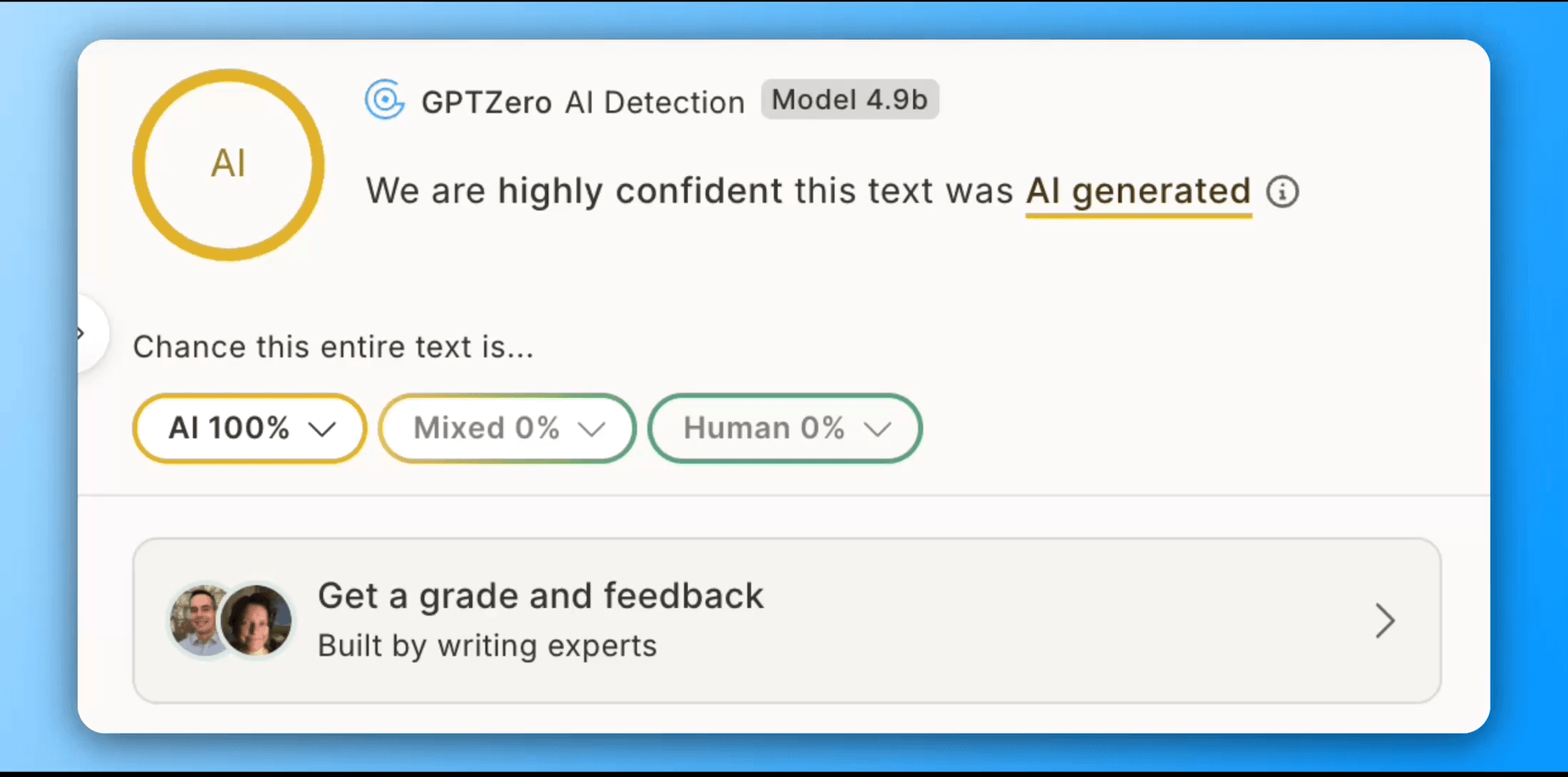
GPTZero is an AI-text detector that estimates how likely a passage came from a language model and highlights the sentences that triggered the estimate. Edward Tian, then a Princeton senior studying computer science and journalism, posted the first version on 1 January 2023 as a New Year's Day side project; roughly 30,000 people tried it within a week. He co-founded the company with Alex Cui shortly after.
Funding followed fast: a $3.5 million seed round in May 2023, then a $10 million Series A led by Footwork VC in June 2024, for $13.5 million in total.
One detail I couldn't pin down: nobody agrees how many people use GPTZero. One account traces growth from 1 million users in mid-2023 to 4 million a year later. Another says "over 10 million." A third says "over 19 million." GPTZero's own site banner reads "trusted by 5M+ writers." That's four numbers, and I found no source reconciling them.
How GPTZero Detects AI Writing
GPTZero's detection rests on two statistical measures, with a classifier layered on top.
- Perplexity measures how predictable each word choice is to a language model. AI output tends to be predictable, which produces low perplexity. Human writing wanders more.
- Burstiness measures variation in sentence length and structure across a document. Models write at an even pace; people mix short sentences with long ones.
The current product is a seven-component model built on those two metrics: deep-learning classifiers trained on labelled samples, a module trained on student essays, sentence-level and document-level predictions, mixed-content detection that separates AI-written passages from human ones in the same document, and an ESL debiasing layer added in response to the false-positive problem covered below.
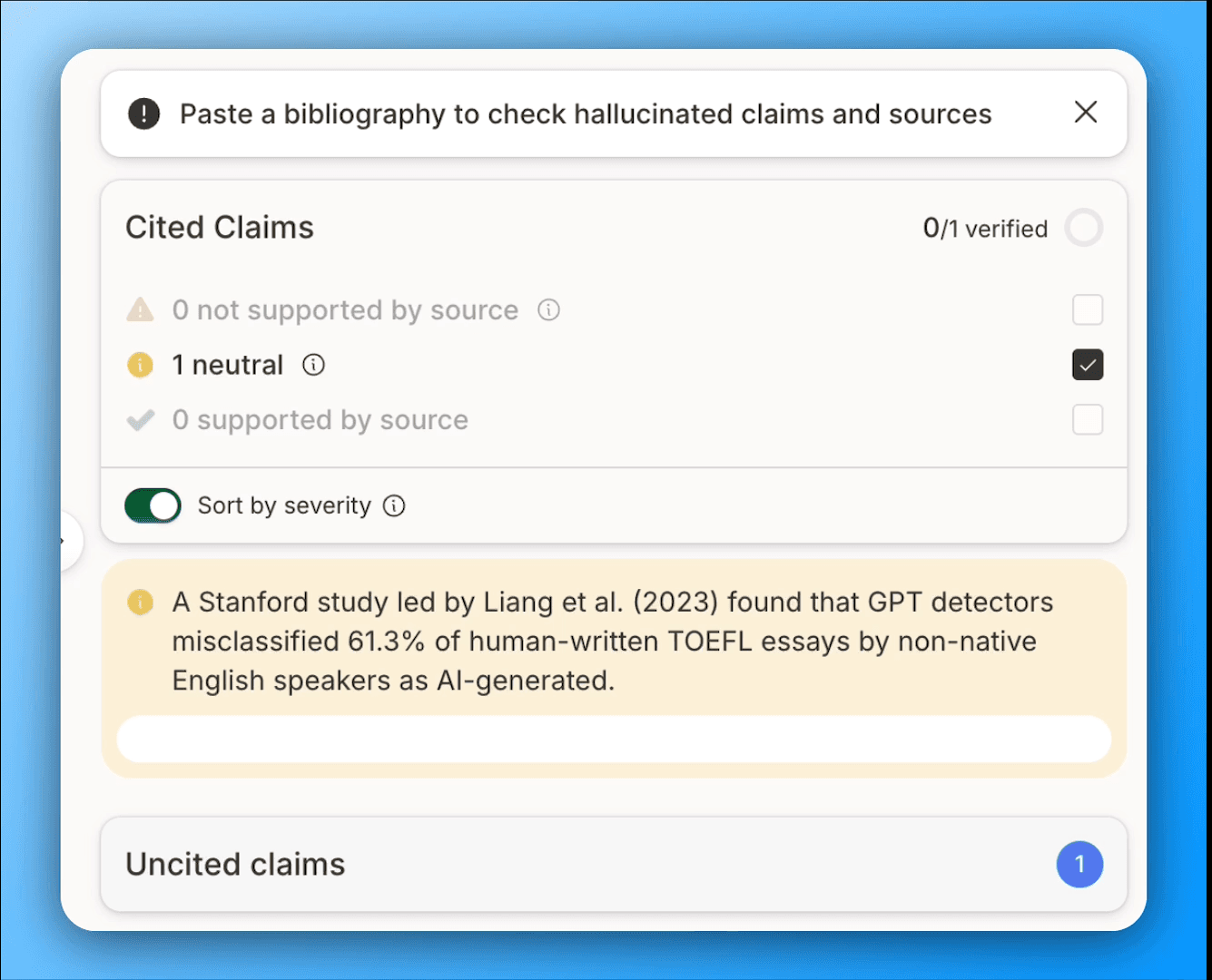
Beyond detection, I found hallucination flagging, a writing-sample comparison that checks a submission against a known sample from the same author, an AI Grader for batch-uploading student work, LMS integrations, a Chrome extension, and multilingual detection with accuracy that varies by language.
How Accurate Is GPTZero?
GPTZero's marketed accuracy and its independently measured accuracy differ by more than 40 percentage points. Both numbers are real. They measure different things, and the difference is the most useful thing to understand before you trust a score.
What GPTZero Claims
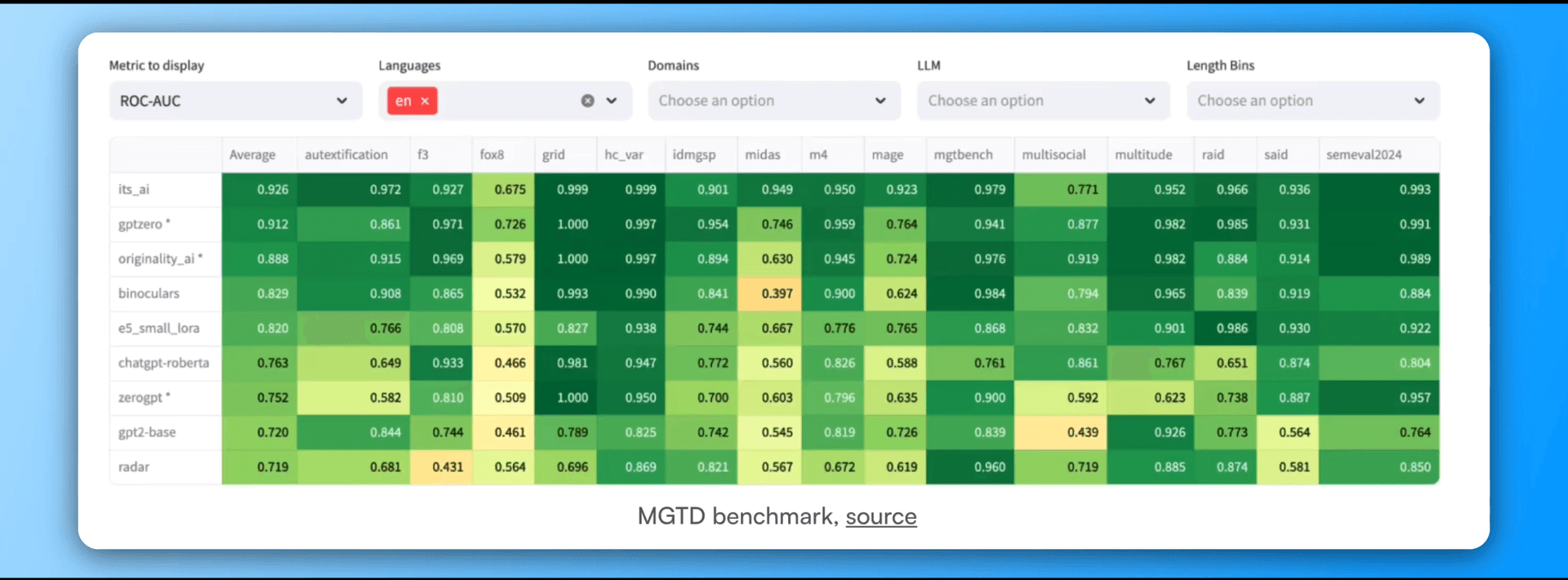
On the RAID benchmark (672,000 texts across 11 domains, with 12 adversarial attacks), GPTZero reports a 95.7% true positive rate at a 1% false positive threshold. A 2026 University of Chicago Booth School benchmark recorded 99.3% recall at a 0.24% false positive rate on unedited AI text. GPTZero also cites 99% accuracy once discontinued older models are filtered out.
What Independent Testing Found
| Test | What it measured | GPTZero's result |
|---|---|---|
| Scribbr, 10 detectors | Overall correct identification | 52% (below the test's 60% average) |
| Pangram Labs, 30 detectors | 9 AI samples, 3 human samples | 7/9 on AI (78%), 3/3 on human |
| Weber-Wulff et al. (2023) | 14 detectors | "Neither accurate nor reliable"; most below 80% |
| Perkins et al. (2024) | 7 detectors under adversarial editing | Category accuracy fell from 39.5% to 17.4% |
| PMC study | False positive rate | 10% against GPTZero's claimed 0.24% |
Pangram's result is the most favourable of the set, and Pangram builds a competing detector, so it had no reason to flatter GPTZero. Scribbr's 52% is the harshest. Both used a consistent method; they used different samples.
Why the Two Numbers Disagree
Clean benchmarks and real submissions are different tests. On unedited output straight from ChatGPT, Claude or Gemini, GPTZero performs close to its claims. On text a person has edited, paraphrased or run through a rewriting tool, accuracy collapses, and edited text is what students submit. Perkins et al. quantified the collapse: simple adversarial techniques cut detector accuracy from 39.5% to 17.4%. GPTZero's own documentation also acknowledges that accuracy falls sharply below 250 words, which rules out most short-form writing.
The False-Positive Problem
A Stanford study led by Liang et al. (2023) found that GPT detectors misclassified 61.3% of human-written TOEFL essays by non-native English speakers as AI-generated. That's the number I'd weigh most, because the people it hits hardest are the ones least able to argue back.
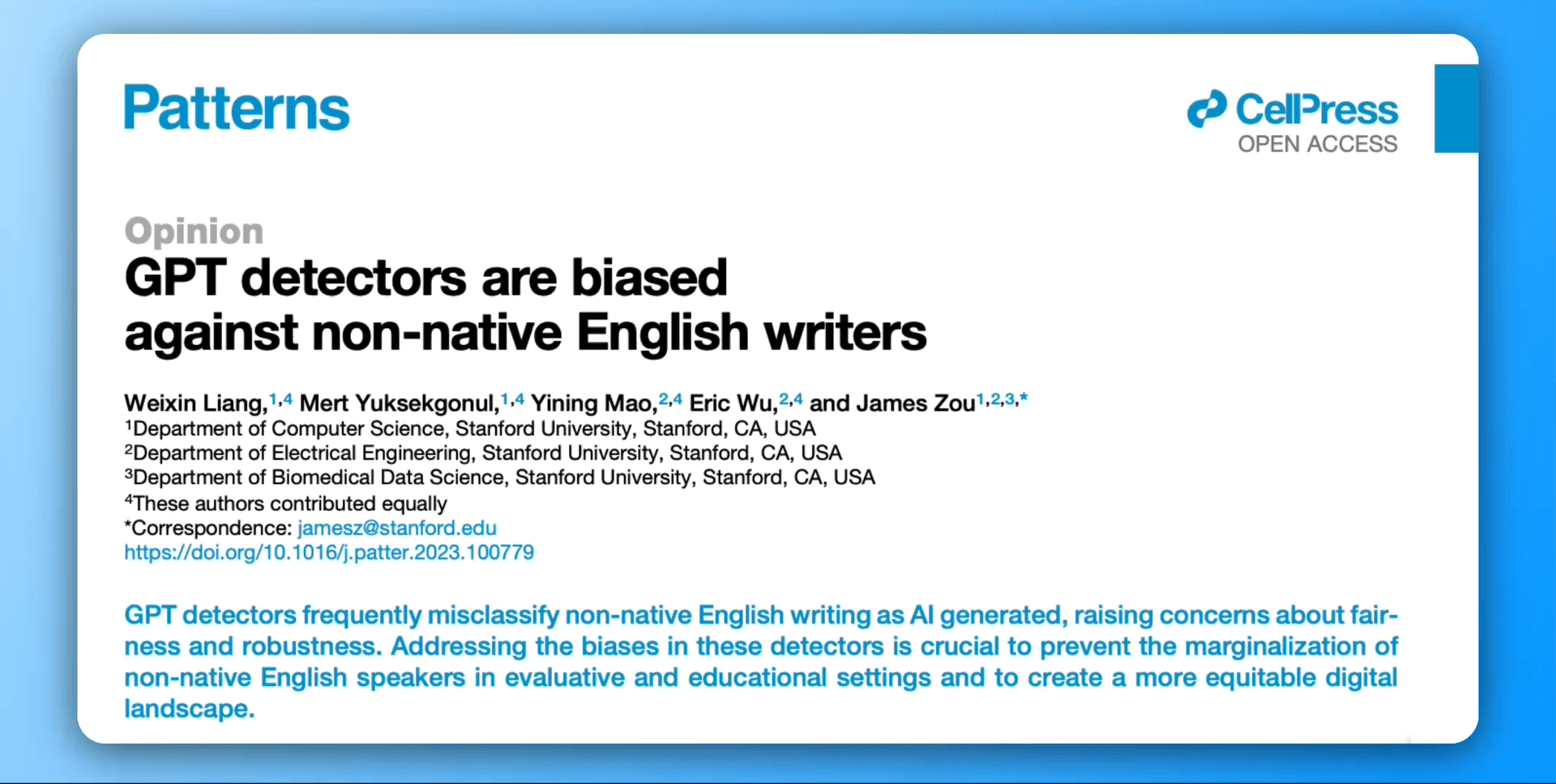
The same study found something worth sitting with: increasing the linguistic diversity of that ESL writing dropped the false positive rate from 61.3% to 11.77%. Making the writing more elaborate made it look more human to the detector, which tells me the detector is measuring style, not authorship.
Four writer profiles get flagged disproportionately:
- Non-native English speakers, for the reason above
- Students who write formally and well, because organised prose with standard transitions resembles model output
- Technical and scientific writers, whose standardised phrasing and methodical structure trigger the same signals
- Anyone submitting under 250 words, where GPTZero itself says confidence drops
Institutions have responded. At least 12 universities, including Vanderbilt, Yale, Johns Hopkins and Northwestern, have disabled AI detection entirely, citing false positives and ESL bias. UT Austin banned purchasing AI detection tools in 2024. GPTZero's own team publishes guidance against treating a score as the sole evidence in a misconduct case, which is unusually candid for a vendor and worth taking at face value.
GPTZero Pricing
I found five different price ladders quoted for GPTZero's plans, and none of those sources acknowledges the others exist. This was the clearest finding in my research, so I'm laying it out plainly instead of picking one number and moving on.
| Source | Entry paid tier | Next tier | Notes |
|---|---|---|---|
| Pangram Labs | $14.99/mo | n/a | 150,000 words/month |
| Leap AI (verified April 2026) | $14.99/mo | $23.99/mo | ~$9.99/mo billed annually |
| Walter Writes | $8.33/mo | $12.99, then $24.99 | Four tiers named |
| AIDetectPlus | $23.99/mo | $45.99/mo | 300,000 then 500,000 words |
| JustDone | $155.88/year | n/a | Works out to ~$12.99/mo |
| AI Overview | $9.99-14.99/mo | ~$23.99/mo | n/a |
Two pairs corroborate each other. Pangram and Leap AI both land on $14.99 monthly. Walter Writes' $12.99 and JustDone's $155.88 annual figure are the same number expressed two ways. AIDetectPlus is the outlier at nearly double everyone else, and AIDetectPlus sells a competing product.
The free tier is the one figure the sources agree on: 10,000 words per month plus five advanced scans. A single 2,000-word essay uses a fifth of that allowance, which is a tighter constraint than the feature gating.
I haven't confirmed any figure above against gptzero.me, so check the pricing page before you commit.
What GPTZero Does Well
- Institutional integration nothing else matches. Canvas, Google Classroom and Moodle integrations, SOC 2 certification and FERPA-aware agreements. Leap AI, a competitor, said outright it wouldn't try to compete in that segment.
- It leaves clean human writing alone. Pangram's test cleared 3 of 3 human samples, and in my seven-sample test GPTZero scored every human sample at 0% AI. That's a real strength, and the opposite of ZeroGPT's behaviour.
- A public research trail. GPTZero has been tested and cited in published research more than any other consumer detector, which matters if a score ever needs defending.
- Candour about its own limits. GPTZero's team publishes guidance on false positives and non-native writers instead of hiding it. Few vendors in this category do.
- Sentence-level output. Seeing which sentences triggered the flag turns an unexplained percentage into a reviewable result.
Where GPTZero Falls Short
- Independent accuracy sits far below the marketing. 52% on Scribbr's test and 78% on Pangram's, against 95.7% claimed.
- Documented ESL bias. 61.3% false positives on TOEFL essays by non-native speakers, per the Stanford study.
- Wildly inconsistent across content types. In my stress test it scored AI-written creative writing at 100% and an AI-written social media post at 4%, a 96-point spread that makes any fixed threshold meaningless.
- Score instability. I scanned the same 1,000-word essay twice, minutes apart with no edits, and got 45% and then 22%.
- Detection only, by design. No humanizer, and no plagiarism check on lower tiers. GPTZero's team has said it won't build humanization tooling because it works against its educational mission.
- Persistent upselling. I hit repeated upgrade prompts, advanced features locked behind "0 advanced scans left," and an "AI Vocab" tab that returned no results at all.
Can GPTZero Be Bypassed?
Yes, and the published research is unambiguous about it. Perkins et al. (2024) found that simple adversarial editing dropped detector accuracy across the category from 39.5% to 17.4%. A 2025 study on adversarial paraphrasing measured roughly an 85% reduction in detection rates with only minor quality loss. Walter Writes ran its own demonstration: an essay GPTZero flagged as AI came back as 91% human after a humanizing tool rewrote it.
I don't name those tools, rank them, or explain the workflow. Using one to pass AI-written work off as your own is academic misconduct at essentially every institution that runs a detector, and the person submitting carries the consequences. If a detector flagged writing that is yours, the useful response runs the other way: keep your draft history, ask for a conversation, and cite the Liang and Weber-Wulff studies, which is what GPTZero's own guidance recommends.
Frequently Asked Questions
Is GPTZero accurate?
On unedited output from ChatGPT, Claude or Gemini, largely yes. On edited or paraphrased text, no. Independent tests put it between 52% (Scribbr) and 78% (Pangram) against a claimed 95.7%, and Weber-Wulff et al. found no detector in a 14-tool study reliable enough to act on alone.
Is GPTZero a trustworthy website?
The company is legitimate: named founders, $13.5 million in disclosed funding, SOC 2 certification, FERPA compliance and a published research record. Trustworthy as a company and accurate as a detector are separate questions, with different answers.
Is GPTZero worth paying for?
For institutions that need LMS integrations, yes. For individuals, the free tier's 10,000 words a month covers most casual checking, and paying mainly buys volume rather than better detection.
Is GPTZero as reliable as Turnitin?
No, on the evidence I found. Turnitin holds false positives under 1% by deliberately letting roughly 15% of AI content pass, per its own Chief Product Officer. GPTZero's measured false positive rate runs closer to 10%. I cover the full comparison in GPTZero vs Turnitin.
Why does GPTZero say I used AI when I didn't?
Four profiles get flagged most: non-native English speakers, students who write formally and well, technical writers, and anyone submitting under 250 words. GPTZero measures statistical style rather than authorship, so polished, uniform writing reads as machine-written to it.
Is GPTZero the same as ZeroGPT?
No. They're separate companies with confusingly similar names and different accuracy, and ZeroGPT flagged 2 of 3 human samples as AI in Pangram's testing. See GPTZero vs ZeroGPT.
What are the best GPTZero alternatives?
Copyleaks scored 9/9 on AI samples and 3/3 on human samples in Pangram's 30-tool test, the only perfect result in the set. The full comparison is in GPTZero alternatives.
Ready to try GPTZero?
We may earn a commission when you buy through links on this page. It never changes what we recommend, and the price you pay is the same either way. How we make money
More on GPTZero
GPTZero Alternatives
GPTZero vs Turnitin
GPTZero vs ZeroGPT
(keep reading)
Typefully Review
Typeless Review
WriteHuman AI Review
Get the AI tool roundup.
One email a week: what launched, what is actually worth paying for, and what to cancel. No hype, no spam.
Unsubscribe any time. We never sell your email.