Perplexity Review
After testing Perplexity myself, I found its core pitch of cited, real-time answers holds up, but 'cited' doesn't mean 'verified.'
We may earn a commission when you buy through links on this page. It never changes what we recommend, and the price you pay is the same either way. How we make money
Yes, if your work involves regular research. Perplexity's core pitch of fast, cited, real-time answers holds up under my testing, and the free tier alone is a genuine Google replacement for a lot of everyday searches.
Is Perplexity Worth It?
Yes, if your work involves regular research. Perplexity's core pitch of fast, cited, real-time answers holds up under my testing, and the free tier alone is a genuine Google replacement for a lot of everyday searches. The more useful question than "is it worth it" is "is it trustworthy," and the honest answer is more specific than a blanket yes or no: Perplexity's citations are real links, but they don't always say what Perplexity claims they say. That distinction, backed by examples from my own testing, is worth understanding before you lean on it for anything you'll publish or present.
Perplexity's Pricing: Free, Pro, and Beyond
| Plan | Price | Best For |
|---|---|---|
| Free | $0 | Casual research, unlimited standard search, a limited number of daily Pro Searches |
| Pro | $20/mo | Frequent researchers: 300+ daily Pro Searches, model switching (GPT, Claude, Gemini, Grok), file uploads, image generation |
| Education Pro | $5/mo | Students and educators with a .edu email: full Pro features plus expanded citations and study tools |
| Max | $200/mo | Heavy, high-volume research workflows: unlimited access across the full model suite, unlimited Labs queries |
| Enterprise Pro | $40/mo | Teams needing internal knowledge search, admin controls, and stricter data privacy |
| Enterprise Max | $325/mo | Large organizations needing top-tier security and scale |
If you're deciding between tiers, the practical logic is straightforward: start on Free, move to Pro ($20/mo) once you're hitting daily Pro Search limits, and only consider Max if you're running research workflows heavy enough to need unlimited access across every available model.
What Perplexity Actually Does Well
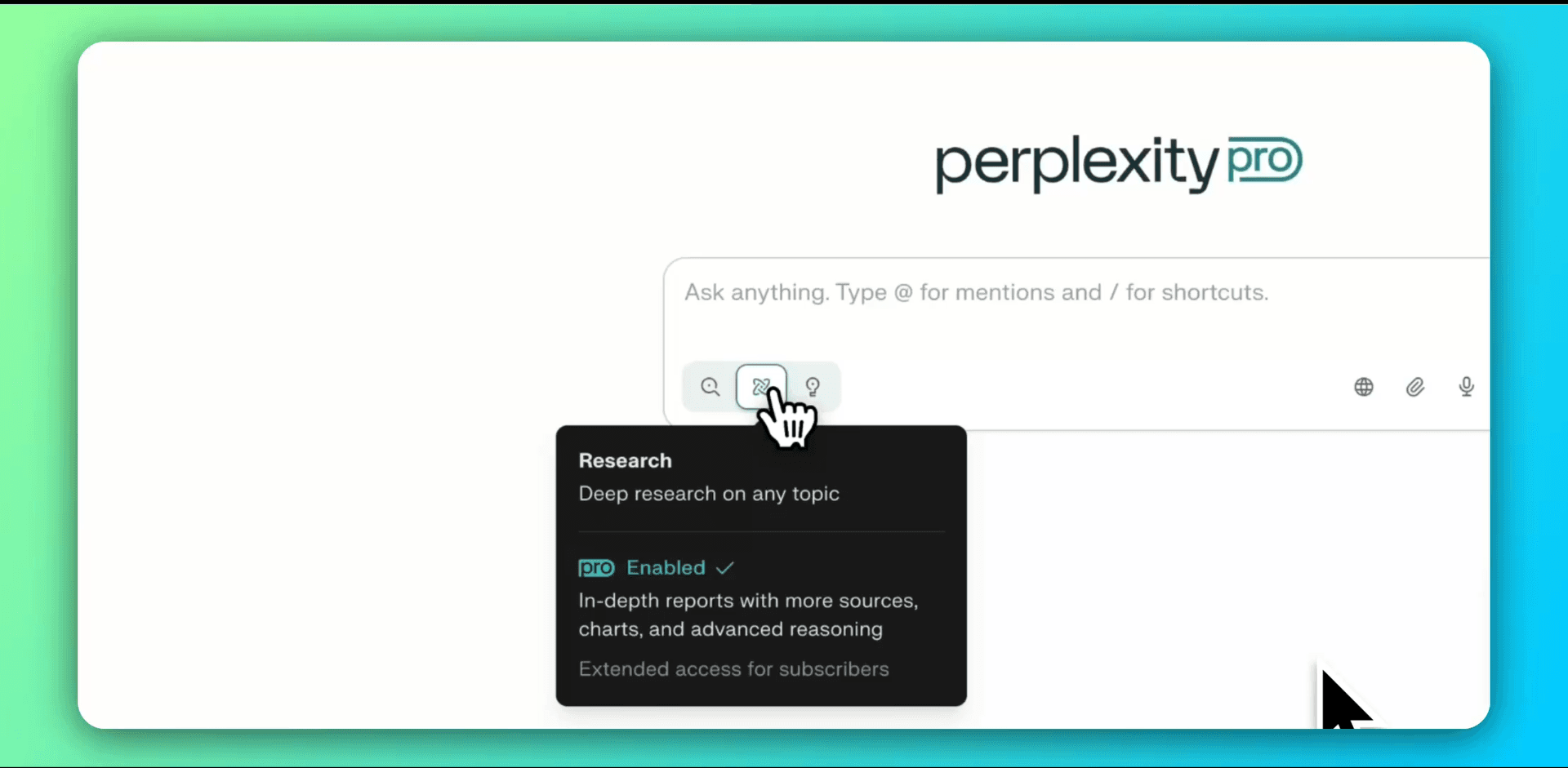
Perplexity's strength is real-time, cited synthesis. Ask a research question and it pulls from multiple current sources, compiles an answer, and attaches clickable citations rather than making you read ten open tabs yourself. In my testing, it holds up as a genuine Google replacement for research-style queries: it's cleaner, faster, and free of the sponsored clutter that dominates a standard search results page. Model switching on the paid tier (toggling between GPT, Claude, Gemini, and Grok inside one interface) is a real, differentiated advantage, letting me use whichever model suits a given task without juggling separate subscriptions. Specialized Focus modes (Academic for peer-reviewed sources, Finance for real-time market data) and Spaces (persistent, prompt-configured project folders) extend that further for anyone doing sustained research work rather than one-off lookups.
The Citation Problem: Why "Sourced" Doesn't Mean "Verified"
This deserves more specificity than a generic "AI can hallucinate" caveat, because I tested it directly and found four distinct, recurring failure patterns:
- Phantom statistics: Perplexity attributes a specific number to a source, but the number doesn't actually appear anywhere in that article. The AI inferred a plausible figure from the source's general content rather than quoting it.
- Misattributed quotes: a claim gets attached to a named person or organization whose linked source doesn't actually contain that quote.
- Stale content presented as current: Perplexity caches pages, and if a page has since been updated, the citation still looks valid while the claim it supports is outdated.
- Source-quality conflation: a peer-reviewed study, a press release, and a random forum comment all appear as identical numbered citations, with nothing visually distinguishing a rigorous source from a weak one.
In my testing, Perplexity was accurate on a straightforward pricing lookup but ChatGPT clearly outperformed it on tasks like drafting a cold email or debugging a JavaScript function, a useful reminder that citation-backed doesn't mean stronger across the board. The practical fix is direct: click through on any statistic before you publish or present it, and treat Perplexity's citations as leads worth checking rather than verified references.
Where Perplexity Falls Short
Beyond the citation issue, Perplexity is weak at creative writing in my testing (output reads dry and generic, lacking a distinct voice) and weak at coding (no code interpreter, can't run or test what it writes). Users have reported usage limits and subscription terms changing with little notice: reduced limits on features like Deep Research, and annual subscriptions downgraded unexpectedly. If you're considering an annual plan, starting with monthly billing until you've used it for a while is a reasonable hedge given that pattern. Separately, in 2024 Perplexity's web crawler was found ignoring robots.txt directives at scale, accessing content from publishers who had explicitly opted out of AI scraping. The company's response was partial rather than a fundamental change in practice, worth knowing if you have concerns about how your own content gets used.
A Different Product With a Similar Name: Perplexity Computer
If you've seen buzz about "Perplexity Computer," it's not the tool this review covers. Launched February 25, 2026 and gated behind the $200/month Max plan, Computer is a separate, cloud-based agentic system that orchestrates 19+ AI models to research, code, deploy, and manage entire projects autonomously, closer to an AI employee than a search engine. It's a notable product in its own right, but it serves a different purpose (autonomous multi-step project execution) than the search-and-cite research assistant covered above, and conflating the two will leave you with the wrong expectations for either one.
Perplexity vs. ChatGPT: Which Should You Use?
They're built for different jobs rather than competing head-to-head. Perplexity is stronger for current information, source transparency, and research synthesis. Ask it about a competitor's latest pricing or a recent news event and it outperforms a general-purpose chatbot working from training data alone, in my testing. ChatGPT is stronger for writing quality, coding, and structured reasoning once you already have the information in hand. My practical answer: use Perplexity to find and verify current facts, then switch to ChatGPT (or another general-purpose assistant) to write, plan, or reason with what you found. If ChatGPT specifically isn't your pick for that second half, see ChatGPT Alternatives for the field Perplexity gets weighed against throughout this comparison.
Who Perplexity Is For / Not For
For:
- Researchers, marketers, and analysts who need fast answers with sources they can actually check
- Students and academics wanting a starting point for orientation on unfamiliar topics (not for direct academic citation)
- Anyone who wants a cleaner, ad-free alternative to a cluttered Google results page for research-style queries
Not for:
- Anyone treating a Perplexity citation as automatically verified: check the source before using a stat or quote professionally
- Primary creative writing or long-form content work, where the output tends to read generic
- Production coding work, since there's no code interpreter and it can't run or test what it generates
Where This Fits in the Wider AI Writing Toolkit
Perplexity sits in the AI Writing Tools section, alongside ChatGPT (the stronger choice once you're past the research stage and into writing or reasoning) and Google Gemini.
Frequently asked questions
Is Perplexity AI trustworthy?
More trustworthy than a chatbot with no sources, since you can click through and check its claims. Not automatically, though. My testing found specific, recurring ways its citations can mislead: numbers attributed to sources that don't contain them, quotes that don't match the linked page, and outdated cached content presented as current. Treat it as a well-sourced starting point, not a verified reference.
Is Perplexity better than ChatGPT?
For real-time research and source-backed answers, yes. For writing quality, coding, and structured reasoning, no. ChatGPT is stronger there. Most people get the most value using both for what each does best rather than picking one.
What is the downside of Perplexity?
Its citations can be confidently wrong in specific ways (misattributed quotes, stale cached data, source-quality conflation), it's weak at creative writing and coding, and users have reported usage limits and subscription terms changing with little notice.
Is Perplexity worth it anymore?
Yes, for research-heavy work. The free tier alone still beats manually Googling and reading through multiple tabs for most fact-finding tasks, and Pro's $20/month price is easy to justify if you're hitting free-tier limits regularly. It's less clearly worth it if your main use case is writing or coding rather than research.
Is Apple going to acquire Perplexity?
Not confirmed, and no acquisition has happened. Bloomberg reported in mid-2025 that Apple executives held internal talks about acquiring Perplexity, at a valuation reportedly near $14 billion, but Perplexity said it had no knowledge of any M&A discussions, and by mid-2026 reporting described the talks as stalled with no deal announced. Worth watching if you're relying on Perplexity long-term, but nothing here changes today's product or pricing.
Ready to try Perplexity Pro?
We may earn a commission when you buy through links on this page. It never changes what we recommend, and the price you pay is the same either way. How we make money
(keep reading)
Typefully Review
Typeless Review
WriteHuman AI Review
Get the AI tool roundup.
One email a week: what launched, what is actually worth paying for, and what to cancel. No hype, no spam.
Unsubscribe any time. We never sell your email.